After years of investigation and prosecution, a nearly $20 million bank fraud scheme that struck at the heart of downtown Springfield has finally reached its conclusion. The three co-conspirators have been sentenced, ordered to serve a combined 6 years and 4 months in prison and to pay a total of $36,798,667 in restitution. Each also received at least three years of supervised release.
Though the final sentences have been handed down, the damage is not fully undone.
Longmeadow real estate investor and restaurant owner Louis Masaschi, along with his wife, Jeannette Norman, and sister-in-law, Christine Gendron of Feeding Hills, perpetrated a scheme to defraud commercial lenders by providing false and fraudulent rent rolls and forged lease agreements for properties located in Springfield, East Longmeadow, and Enfield, Connecticut. They then defaulted on their loans, causing more than $18 million of losses to the lenders, including two community credit unions—Freedom Credit Union and Workers Credit Union. Masaschi was sentenced in July to four years in prison, followed by three years of supervised release, and ordered to pay $18,203,030 in restitution. Gendron was sentenced a week later to one year of confinement—six months in prison, six months under home confinement, and three years of supervised release—and ordered to pay $392,607 in restitution. Norman’s sentencing was the last to take place, on Sept. 30, and her sentencing was similar to her husbands, as she was ordered to 22 months in prison, followed by three years of supervised release with four months in home confinement, with an order to pay $18,203,030 in restitution.
The banks and lenders that lost millions are, rightfully, victims of this scheme. But there is another victim whose losses cannot be measured on a balance sheet: downtown Springfield itself.
The fraudsters left many downtown buildings vacant, abandoned, and in worsening disrepair over many years, resulting in substantial loss of value, increases in rehabilitation costs, and ultimately, a worsening economic picture for Springfield’s downtown.
Right outside the doors of MGM Springfield, multiple buildings fell victim to their scheme. Three buildings part of a $68 million redevelopment project by an out-of-state developer, McCaffery Interests, are among the victim properties. The Clocktower Building at State and Main Streets, the Colonial Block building at 1139-1155 Main St., and 11-21 Stockbridge St.
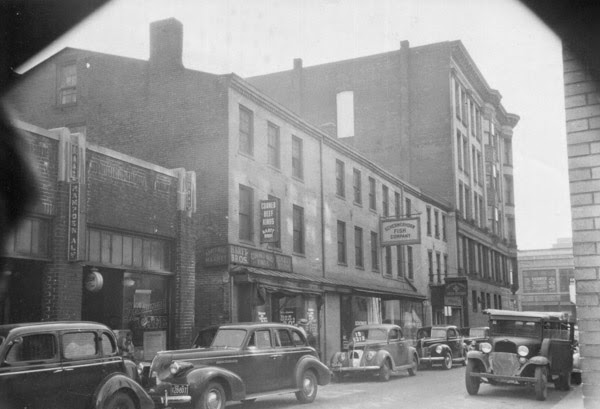
Sandwiched between the latter two buildings is another victim building, 7-9 Stockbridge St., the third oldest building in downtown Springfield, which is in active historic restoration by nonprofit the Springfield Preservation Trust, where I serve as president of the board of directors.
When the Trust acquired 7-9 Stockbridge Street in 2023, the building was in need of a roof, full exterior restoration, installation of all utilities, and complete rehabilitation of all interiors. Because the roof was open, there were active water and mold issues—and extensive structural issues were also found post-acquisition. This building was operational in the early 2000s—after Masaschi, Norman, and Gendron got their hands on it, however, it fell into a state of near disrepair with many developers passing it over as a “teardown.” It is now a $1.8 million restoration project, for a building purchased for $180,000 with an after-repair value of around $400,000. That is a massive loss. Thank goodness we are a nonprofit with a mission to protect, preserve, and promote historic properties in Springfield. No other developer could make these numbers work.
All four of these buildings fell victim to Masaschi, Norman, and Gendron’s fraud scheme. And all four of these buildings are of historical and architectural significance to the “City of Firsts.” All but one make that easily evident—11-21 Stockbridge Street sports a ghastly mid-century modern facade, but was originally constructed alongside 7-9 Stockbridge Street in 1845 in contiguous Greek Revival commercial style.
This bank fraud did not just affect financial institutions. It affected the fabric of our community. It put massive stress on important historical buildings. It caused tens of millions of dollars in additional repair costs for developers. Surely, as savvy real estate entrepreneurs, they knew the typical outcome for buildings left vacant and boarded up. And yet, they kept digging.
But the damage cuts deeper.
While these buildings sat vacant and underutilized, they lent to reduced tourism and economic activity in our city center. Located centrally in the MGM Springfield Redevelopment Area, these buildings sat unable to be redeveloped, because greedy fraudsters held title.
Springfield continues to suffer from a reputation of being unsafe or unsavory—our dilapidated downtown is central in that narrative. Downtown Springfield has been in active revival for decades, but vacant buildings are holding us back. Residents and visitors are less inclined to stroll downtown when every other building is boarded up.
Streets like Stockbridge Street suffer—it’s not a welcoming atmosphere when the majority of the buildings on the short street are vacant. Our city has done what it can, attracting a national developer and even stringing up decorative canopy lights to really cheer the place up.
But this fraud scheme prolonged vacancies of these four buildings and many others in Springfield and the surrounding area, and increased the time and costs for their repair. They also caused even greater damage in the form of economic and reputational repression which keeps our city from reaching its full potential. How unfortunate is it that tens of millions of dollars are being funneled to these properties because of these rapacious financial crimes? Those funds could have been directed elsewhere in a city in need of much.
As this week’s final sentencing brings this chapter of the charges against Masaschi, Norman, and Gendron to a close, may the work already underway to repair the damage and rebuild our downtown move forward swiftly and successfully. May downtown Springfield not be forgotten—and may those out-of-town, vulturous criminals think twice before defrauding Springfield’s Main Street again.
Erica Swallow lives in Springfield. She is a former editor and journalist, having started her career in social media at The New York Times. Her work has been published in Forbes, Fortune, Entrepreneur, and The Wall Street Journal, among other publications.


